Accessories

Posts in the History Category

“Fluke” Encouter

WS Holland, Johnny Cash's one and only drummer.

WS Holland, Johnny Cash’s one and only drummer. Photo credit: bestdamnshows.com.

WS in his Johnny Cash  tunnel race boat.

WS in his Johnny Cash tunnel race boat. Photo courtesy Krista Holland.

I began my career with Mercury Racing in 1988 as a Product Support Specialist. I traveled throughout the country supporting stock outboard and  Formula 1 tunnel boat racing.

St. Louis was the Indy 500 of outboard tunnel boat racing. Racers and fans from around the world would converge on George Winter Park to watch hometown favorites, the Seebold’s, defend their turf. I was working the parts truck one year when Mike Butler (Race Sales Manager at the time) was talking with an older gentleman about tunnel boat races from days gone by and variety of other topics. Mike then introduced me to the gentleman. He was WS Holland, Johnny Cash’s drummer. I had to step back and process who I had just met. I couldn’t believe it! I’m a music lover and drummer as well. The chance of meeting someone like WS at a boat race was very cool and as I would find out later, more than a fluke encounter.

WS checking out the competition during time trials in Portsmouth, Ohio.

WS checking out the competition while waiting his turn to qualify for a race. Photo courtesy Krista Holland.

Boat racing was a family affair for the Holland's. Photo courtesy Krista Holland.

Boat racing was a family affair for the Holland’s.

I was impressed at how humble and down to earth this man was. It’s been over 20 years since WS and I have spoken in depth.  My impression hasn’t changed. Read the rest of this entry »

7

Virtual Tour – Part 1: Introduction

Mercury Racing World Headquarters - Fond du Lac, Wisconsin.

The author - Senior Tour Guide and Marketing guy.

“Welcome to  Mercury Racing.  Nice to Have You Here!” is the first thing most visitors hear upon entering the reception area of our Fond du Lac, Wisconsin headquarters. For over 15 years, I’ve welcomed visitors from all parts of the globe who come for a personal tour of our operations. It’s fun to meet people who enjoy our products. I love to see their expressions and hear their comments. All leave with a better understanding of what we do as a business, the services we provide and products we produce. One of the big things people leave with:  an appreciation for the “sweat equity” that goes into all facets of production. Visitors are amazed at the hand-craftsmanship and palpable pride that our people put into our products.

This is the first in a series of posts featuring a virtual tour of Mercury Racing. Text and still photos will be complimented with high definition video shot by John Potts of American Performance Television. Before we begin, we need to review a bit of history. Read the rest of this entry »

4

Team Mercury – Part 3: Earl Bentz

Earl in the "Big Bore T-4" powered Seebold. Photo credit: Boatracingfacts.com.

Photo from 1980 Popular Performance boat magazine feature on Earl.

“My racing days hold many fond memories for me. Being part of the Mercury Racing Team made it possible for a young country boy from South Carolina to go places, do things, and meet people from all over the world that would have otherwise never happened.” wrote Earl Bentz, regarding his time driving for Team Mercury.

Earl credits his uncle, D.F. Jenkins [Jenkin Outboard, Charleston, SC]. for getting him into racing. He ran his first race at age 16 on Lake Murray, South Carolina. “Blue Goose” was the name of the boat, a 100 h.p. Mercury-powered deep-vee.

“My uncle bought me my first tunnel boat over the Winter of 1968-69. It was a Galaxie tunnel boat powered by a stock V-4 Johnson that qualified me for Sport J class. One of my all-time favorites was the ‘Wild Geechee’. It was a kneel-down tunnel with a ‘crash’ throttle. We probably won 80% of the races we entered. One year in particular, we won 20 consecutive races in classes from Sport J all the way to U and S class [unlimited single engine outboard],” said Earl.


Read the rest of this entry »

9

Team Mercury – Part 2: Reggie Fountain

Reggie in a Team Mercury Seebold hull during the 1978 season. Photo Credit: Fountain 25th Anniversary book.

Reggie checks the rigging on this Mercury Twister II powered hull. Photo Credit: Fountain 25th Anniversary book.

“That boat was a rocket sled!” said Reggie Fountain about his first boat with Team Mercury.

Reggie began racing in 1954. He was 14. He started in B class hydros and runabouts. When I asked about engines, “I’ve always used nothing but Mercury’s….My first race engine was a Super 10 Hurricane with Quincy straight pipes. They were very loud. The hydro ran 60-70 mph which was pretty fast back then,” said Reggie.

Reggie claims the first thing he wanted after law school was to race. He bought a tunnel boat in 1968. “It was a twin-engine, 21-foot Glastron…I did pretty well at local races. You could tell the difference between independent boats like mine and the ones from the factories,” said Reggie. “My boat weighed 775-780 lbs, less driver. Joe Felder [on Glastron's factory team] had an identical rig – but much lighter at 515 lbs.”  Reggie saw the advantage of factory support and the need to build a factory network. Read the rest of this entry »

20

Team Mercury – Part 1: Bill Seebold

Team Mercury core drivers (L-R): Reggie Fountain, Bill Seebold, Earl Bentz.

TEAM Mercury tunnel boats featured in the cover of the 1978 Mercury Hi-Performance product catalog.

A recent discovery of classic photos of the Team Mercury outboard tunnel boat race team rekindled my curiosity of the outboard factory war era when Mercury and OMC (Outboard Marine Corporation – parent company of the Johnson and Evinrude brands at the time) battled for bragging rights (and sales) across the globe.

I thought it would be interesting to interview the team drivers to hear first hand what it was like racing for Team Mercury. Read the rest of this entry »

On Their Own Plane

The cover of the original K-Plane Trim Tabs brochure.

K-Planes continue to prove themselves in offshore powerboat races around the globe. Photo credit: Paul Kemiel Photographics.

I was going through my literature archives the other day and came across a copy of the original Kiekhaefer Aeromarine, Inc., K-Plane Trim Tabs sales brochure. I’ve always respected the quality and functionality of Kiekhaefer’s literature.  I  thought a blog post regarding the history of K-Plane trim tabs would be of interest. More importantly, it will serve as a refresher regarding the fit, form and function of the world’s most durable trim tabs.

Kiekhaefer Aeromarine Motors first introduced K-Plane Trim Tabs in 1970.  They were designed to keep the fastest, hardest running racing boats on an even keel in just about any water condition. US (APBA) and World Offshore (UIM) champions, Doc Magoon and Carlo Bonomi ran nothing else. In the mid 70s, Fred Kiekhaefer upgraded the product for recreational use. Read the rest of this entry »

13

Let it Snow!

Mercury studio photography of the legendary Sno-Twister.

Polaris race sleds, fitted with potent 800cc three-cylinder Kiekhaefer Aeromarine two-stroke engines making over 120 hp, won three consecutive USSA championships.

For some reason the colder weather and recent snow flurries has me reminiscing about Mercury Snowmobiles. Remember those? The infamous “lead sleds” (Mercury’s early and very heavy snowmobile – appropriately nicknamed) and legendary Sno-Twisters (when Mercury got it light and right)? Fred Kiekhaefer can expound more on the history: Fred has first hand experience with engineering, development and production of high performance two-stroke engines. Kiekhaefer Aeromarine Motors (KAM) supplied various snowmobile manufacturers in the early 1970s. Fred was VP of Engineering at KAM during Carl Kiekhaefer’s snowmobile engine years. A greatly expanded Mercury Racing is headquartered in that KAM engine facility today.

I was born and raised in Sault Ste. Marie – on the Eastern end of Michigan’s Upper Peninsula.  The ”Soo” as it is often called, gets bombarded with lake effect snow from Lake Superior. If your into it, the U.P. offers hundreds of miles of scenic trails for the snowmobile enthusiast. It’s a great family sport – if you respect the machine and ride safely. Read the rest of this entry »

6

Hello Handsome! Part 3: Details.

The induction system on the 1973 "Champion Maker" needed no styling. Function (here in Doc Magoon's US-1 Cigarette) was in your face!

Communicating the technology within. Some technology is simply beautiful on its face. The induction and air balance system of the QC4v platform required only minor refinement to “style” it. It’s just cool – like the 1970s Kiekhaefer fuel injection trumpets from my dad’s “Champion Maker” Class 1 offshore race engines. With QC4v, some minor shaping and angularity masked the required hoses and clamps, but the inlet runners whisper, “You know why we’re here.” Big air!

Both function and movement are suggested in the exhaust manifold styling.

Cast exhaust manifolds, in a world previously occupied by gleaming polished stainless, was a bigger challenge. We opted to communicate the pulse tuning of the exhaust system through subtle relief in the casting surfaces – indicating the pairing of ports and the side-to-side differences. This also helped function: maintaining a high scrubbing speed of the manifold cooling water. Read the rest of this entry »

1

Hello Handsome! Part 2: Methods.

Inspiration from my "wall": a great looking engine, necessarily buried in frame rails and fenders, is a Ferrari 4.3L V8.

One of my favorite details: side cooling ducts on a McLaren. Flowing elegance, if a bit too busy.

Inspiration. There are a multitude of tools in a stylists arsenal. Before any of them can be used, we have to agree to the physical design constraints which define the canvas. Brainstorming basic design alternatives is a prerequisite to an elegant styling execution (not to mention, functionality). It also requires “the eye.” Stylists see things in many places and contexts where most of us don’t. Inspiration can happen at any time. I keep a photo file of appealing details. Inspiration is everywhere: parking lots, race tracks, concourse events, collector displays, air shows, plumbing show rooms – everywhere. My file becomes a wall during a project like QC4v, but settles in a direction, often reinforcing a theme consistent with product history – the DNA. Choosing one design approach sets many things – including the execution journey and styling constraints. Read the rest of this entry »

Hello Handsome! Part 1: How?

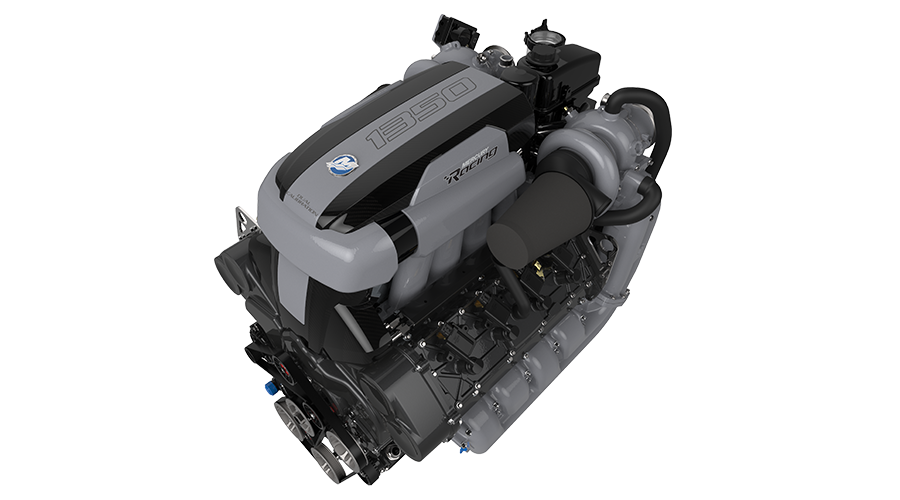
1350 on the dyno at Mercury Racing. With the air boxes and covers removed, one can view some of its inner beauty.

Two years ago, I received a call from Skip Braver, owner of Cigarette Racing. He had just received the first 1350 for his AMG Cigarette: “I don’t want your head to explode, but that is one, handsome engine. Just gorgeous!” Thanks, Skip. Flattering. But how did “handsome” happen?

AMG Cigarette: Form follows function. Beautifully. (Photo courtesy of Cigarette Racing)

Function. First, beauty is deep in the soul of Mercury Racing’s QC4v platform, as well as on the surface: it works as intended; it fulfills the needs and desires of its owners better than any engine offered before. In short, it functions as it should (and better than most customers expected). Function defined the structure.

Form. Second, form followed function. I’ve become somewhat infamous for a comment I made back in the 1980s: “Where is it written, that because it is strong, it must be ugly?” This was a discussion with my manufacturing guy at that time, the late Bill Hackbarth. Bill, a stubborn pragmatist, didn’t like the form of the Kiekhaefer sterndrive (now #6) because he couldn’t figure out how to hold the curvacious upper gear housing in a machining fixture. We changed the form, adding a big lug, so he could clamp it tight. When machining was done, we ground that part back off. Propulsion should look good, but… Form follows function. Read the rest of this entry »