Accessories

Posts in the Tool Kit Category

1

Vital Fluids

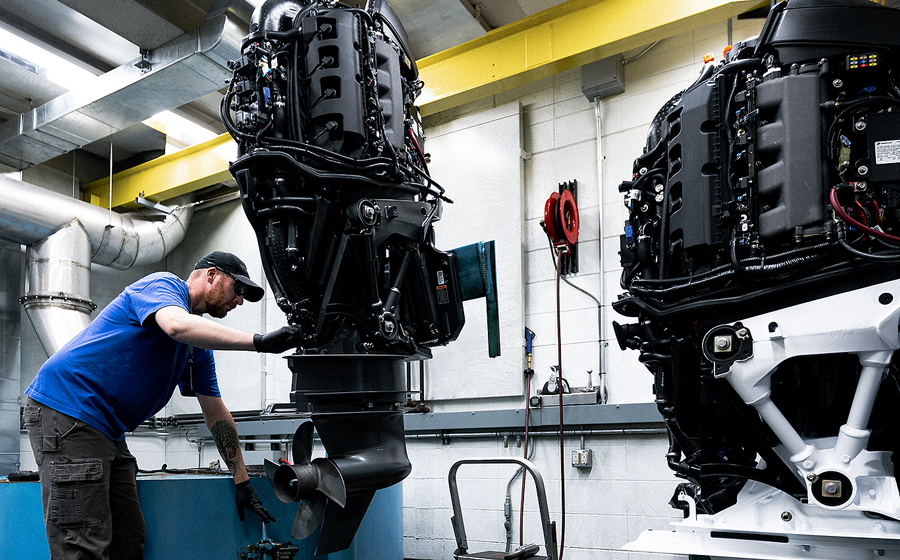
Dyno technician, Dave Dins, running a 1350 for DCB.

Dyno technician, Dave Dins, puts a 1350 through its paces.

OptiMax 300XS powerheads await their turn on the dyno.

OptiMax 300XS powerheads await their turn on the dyno.

We spend a lot of time validating our products. This is because we are responsible for entire propulsion systems – not just independent components. Everything (engines, transmissions, drives and propellers) must work together and be tolerant of each other. This includes oils and lubes. They are the system’s lifeblood.

We validate our engines using specific oil types and weights. Same goes for the drives and  lubes. Over the years, our two-stroke outboards have evolved from carbs to electronic fuel injection to OptiMax low-emissions direct fuel injected technology. Similarly, our higher horsepower sterndrives have evolved from traditional 2-valve, push rod engines to a quad cam, four valve engine of our own design. Oil and lube requirements have evolved along with the products. Read the rest of this entry »

4

Bravo for Go Fast Charters

Captain Sam (L) and his son Joe.

(L-R) Go Fast Fishing Charters Captains Joe and Sam Maisano.

It’s been a year since we introduced the Bravo I FS outboard propeller. It was originally developed for single engine four stroke outboard applications. We’ll, it didn’t take long for the word to spread regarding the prop’s performance. Folks running multiple four stroke outboard rigs started asking for right and left-hand rotation sets of the popular prop.

Bravo I FS test boat: 32-foot Donzi ZF center console.

Twin Verado 300s with 1.75: HD gearcases.

Being the conservative person I am, I opted to first work with a handful of people running various hull types to prove the concept before releasing the counter rotation Bravo I FS models. It took longer than I thought to get feedback from the field.

I  grew frustrated because I wasn’t getting any details regarding performance results. All I would get was, “They’re great! Thanks. ” or more often than not – no news at all. It was like pulling teeth. I found out over time the props worked so well that they wanted to keep their performance secret to themselves. Eventually, I got the detailed information I was looking for and I am happy to share it with you here. Read the rest of this entry »

Bravo on the Bayou

Mercury Marine reps celebrate another BASS Classic victory. (L-R) Scott Reichow, Kevin "KB" Brown, Mike Shedivy, Randy Qualls (Legend Boats), Chris Lane (2012 Classic Winner), Michelle Kilburn, Steve Miller

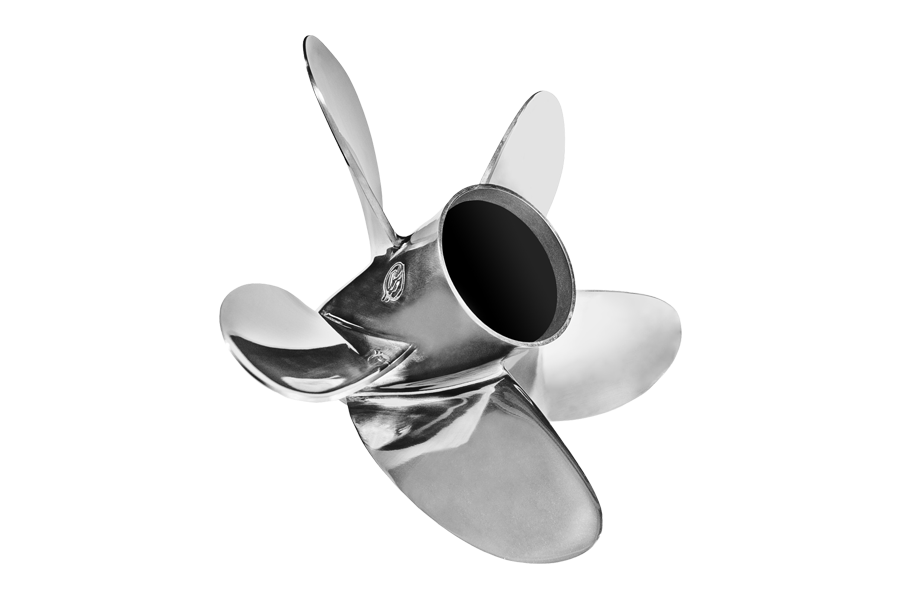
The Pro Finish Bravo I XS outboard propeller features a tuned exhaust tube with large one-inch vent holes for enhanced 2-stroke outboard performance.

I’m fortunate to annually represent Mercury Racing at the Bass Master Classic in the Mercury booth. This year, a fisherman named Rick asked me if there was a Mercury prop that would work for him. He had recently purchased a 2012 Triton 19XS powered by an OptiMax Pro XS 200. Rick was frustrated with the performance. The sharp turns and switchbacks on the Bayou where he runs were causing his propeller to break loose. This forced him to back off the throttle, causing the boat to lose speed and drop off plane. Rick had contacted his Triton representative regarding the issue. Although they discussed various options, the rep suggested Rick continue using a three blade prop.

The performance facts that I gathered in our conversation pointed me to a Bravo I XS. I told Rick the prop is designed specifically for low-emissions 2-stroke OptiMax outboards. Rick responded, “Isn’t Bravo I a sterndrive prop?” Read the rest of this entry »

Hi-Performance Boat Operation – Part 3: Prep & Drive

Pre-run inspection of a 700 SCi powered DCB catamaran. Photo credit: Tres Martin's Performance Boat School.

Twin OptiMax 300XS outboards rigged on a 30-foot Spectre catamaran.

In my previous post (Part 2) regarding high performance boat operation, I reviewed basic information on rigging fit and function. Now its time to head to the ramp.

While the boat is still on the trailer, walk around for a visual inspection of the hull.  Next, climb aboard for a visual inspection of the interior and engine compartment (motor well for outboards): ensure everything is in place and secure. Don’t forget the drain plug(s)!  Check your other safety accessories: aboard? In secure locations?

Helm of a DCB M35 catamaran powered by twin 700 SCi sterndrives.

Helm of 50-foot Cigarette Marauder with twin 1350 sterndrives.

Once your boat is launched,  review the helm to familiarize yourself with the location and function of all instruments and controls. Make sure the steering wheel, throttle and shift controls are well within your reach and that you are comfortable with their operation.

If your boat is fitted with K-Plane trim tabs, be comfortable with the location and operation of the tab trim switches. The driver needs to know the location and function of accessory switches such as bilge blower, bilge pump, running lights, horn, courtesy lights and related fuses, or circuit breakers. Read the rest of this entry »

2

Hi-Performance Boat Operation – Part 2: Rigging Fit & Function

Spring is a great time for newbie and veteran performance boaters alike to get familiar with their craft. For starters, you should review your owners manuals — really, you should — and review the key components of your new boat.

The OptiMax 300XS is very popular for singe and multple engine applications.

The 300XS on this Hydrostream features a 20-inch mid section and Sport Master gearcase.

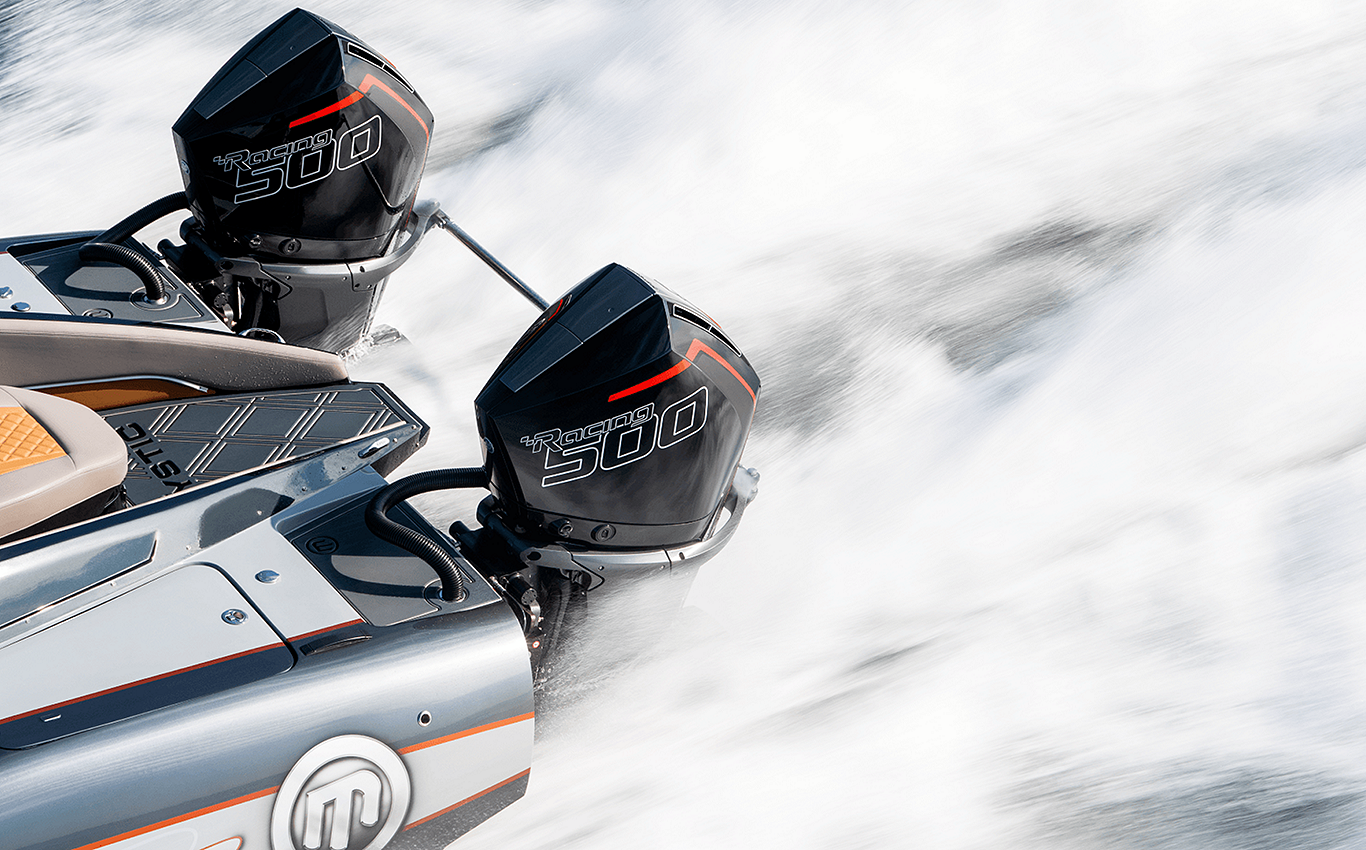
Performance boats vary widely in propulsion and size. Outboards come in 20, 25 and 30-inch drive shaft lengths to accommodate a variety of applications. Mercury (and other brand) outboards are fitted with a standard gearcase for most applications. Hulls that can take advantage of the high power-to-weight ratio of an OptiMax 300XS may benefit from its wide range of gearcase options. Similarly, Mercury Racing offers a variety of sterndrives for differing power capacities and hull types.

Mercury Racing Zero Effort Digital throttles.

Mechanical control: High performance outboards are usually rigged with with dual steering cables, a shift cable, throttle cable and fuel line. With performance sterndrives, throttle and shift are accomplished with cables, but steering is hydraulic. These include 525, 600, 662 and 700 Mercury Racing packages.

Digital control: On SmartCraft Digital Throttle & Shift compatible outboards, such as the Verado 350 SCi and sterndrives including the 565, 1100 and 1350, mechanical throttle and shift cables are gone — replaced with a single electronic cable. Steering is either electric (Verado) or hydraulic (MerCruiser). Read the rest of this entry »

Hi-Performance Boat Operation – Part 1: Introduction

A Nor-Tech catamaran boat powered by twin 850 SCi sterndrives. Photo credit. Florida Powerboat Club.

The boys from Sunsation enjoy their time on the water. Photo credit: Naplesimage.

With Spring in the air, the timing is right to review the basics of high performance boat operation to ensure you and your passengers have a safe and enjoyable Summer on the water. We include a Guide to Hi-Performance Boat Operation with every engine we ship. We encourage new and current owners to review the book and then get some in-boat driving lessons from your local high performance dealer. Those who do not have a qualified driving instructor in their area may want to consider Tres Martin’s Performance Boat School.

Our operation guide is packed with general performance boating information including a list of descriptive terms relating to propellers, hull types and overall boat performance.  Let’s first review the various performance boat hull configurations.

Read the rest of this entry »

On Their Own Plane

The cover of the original K-Plane Trim Tabs brochure.

K-Planes continue to prove themselves in offshore powerboat races around the globe. Photo credit: Paul Kemiel Photographics.

I was going through my literature archives the other day and came across a copy of the original Kiekhaefer Aeromarine, Inc., K-Plane Trim Tabs sales brochure. I’ve always respected the quality and functionality of Kiekhaefer’s literature.  I  thought a blog post regarding the history of K-Plane trim tabs would be of interest. More importantly, it will serve as a refresher regarding the fit, form and function of the world’s most durable trim tabs.

Kiekhaefer Aeromarine Motors first introduced K-Plane Trim Tabs in 1970.  They were designed to keep the fastest, hardest running racing boats on an even keel in just about any water condition. US (APBA) and World Offshore (UIM) champions, Doc Magoon and Carlo Bonomi ran nothing else. In the mid 70s, Fred Kiekhaefer upgraded the product for recreational use. Read the rest of this entry »

3

Prop School – Part 6: Slip

Bob Teague uses Mercury Racing Pro Finish CNC Cleavers exclusively on his 525 EFI powered Skater 388 Super Cat Lite race boat. Photo credit: Paul Kemiel Photographics.

Response to my Prop School series has been been gratifying. It has generated a lot of good discussion (online and off) regarding  propeller design, function and application. One of the most common questions is about prop slip. It is the most misunderstood of all propeller terms.

A wing moving through air produces a pressure differential: low pressure above the wing, with high pressure below it, creates lift.

Propeller blades work like wings on an airplane. Wings carry the weight of the plane by providing lift; marine propeller blades provide thrust as they rotate through water. If an airplane wing were symmetrical (air moves across the top and bottom of the wing equally), the pressure from above and below the wing would be equal, resulting in zero lift.   The curvature of a wing reduces static pressure above the wing — the Bernoulli effect — so that the pressure below the wing is greater. The net of these two forces pushes the wing upward. With a positive angle of attack, even higher pressure below the wing creates still more lift. Read the rest of this entry »

6

Prop School – Part 5: Blade Efficiency

Propellers are available in both right-hand and left-hand rotation. Some hull types with twins respond best with the props "turning out" or away from each other as illustrated.

Turning out.

Rotation. Propellers come in both right and left-hand rotation. Standard rotation for both outboards and sterndrives is right-hand: the prop spins clockwise when in forward gear.  Left-hand props spin counter clockwise.  Left-hand props are typically used with multi-engine applications. The counter-rotation prop works to balance (or reduce) the torque effects from the right-hand prop. Most twin engine applications are setup with the the props “turning in”; the port engine spinning right-hand and the starboard engine spinning counter clockwise. Read the rest of this entry »

119

Walleye Prop

Mercury Racing Lab Finished Bravo I Outboard Propeller.

Mercury Racing Pro Finish Bravo I XS outboard propeller.

You may wonder how we go about testing props. We have a number of our own outboard and sterndrive boats that we use for initial testing. Nevertheless, I’m a firm believer of getting feedback from those who use the product everyday in the real world. Recently, I wanted feedback on performance differences between our Lab Finished Bravo I and Pro Finish Bravo I XS outboard props. My target applications were Walleye and bass anglers.

Read the rest of this entry »